
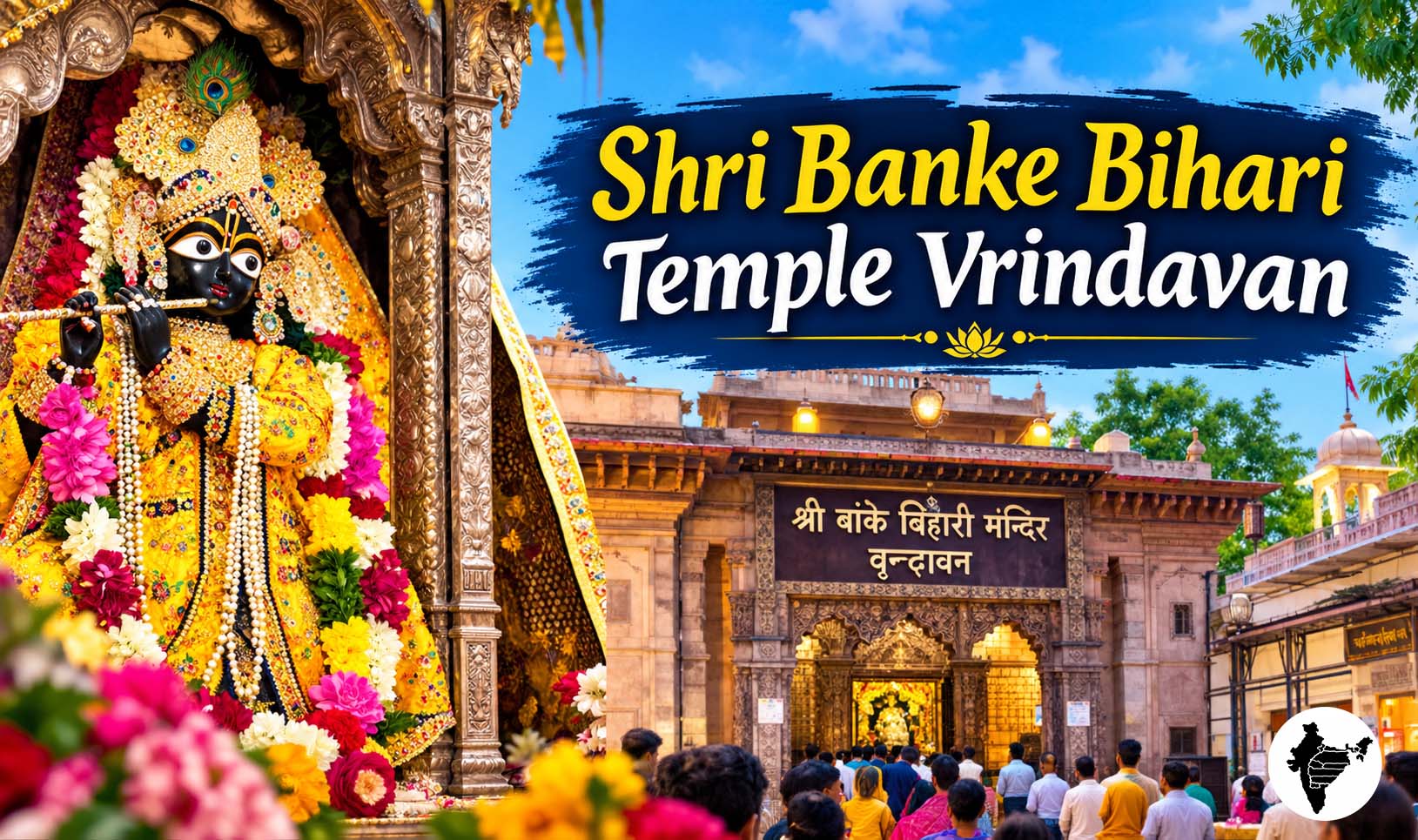
Located in the sacred town of Vrindavan in the Mathura district of Uttar Pradesh, the Shri Banke Bihari Temple stands as one of the most revered pilgrimage destinations in India. Renowned for its spiritual aura, melodic chants of "Radhe Radhe," and deep devotion, the temple holds a unique status among Hindu shrines due to its distinctive customs, sacred origins, and traditional rituals.
1. The Combined Form of Radha and Krishna
Unlike traditional temples where Radha and Krishna are worshipped as separate idols side by side, the deity at Banke Bihari Temple represents the united, unified form of Radha and Krishna in a single black marble icon (vigrah).
Etymology of 'Banke Bihari': In Sanskrit, Banke translates to "bent" or "curved," while Bihari (or Vihari) means "the supreme enjoyer."
The Tribhanga Posture: The sacred idol stands in the classical Tribhanga pose—bent gracefully at three distinct points: the neck, the waist, and the knees. As described in verse 5.31 of the ancient scripture Śrī Brahma-saṁhitā, Lord Brahma glorifies Govinda whose graceful, threefold-bending form of Syamasundara is eternally manifest.
2. History: From the Sacred Groves of Nidhivan to the 1864 Shrine
The appearance of this divine icon is intimately tied to the pure devotion of the revered saint, poet, and classical musician Swami Haridas.
Kunj Bihari to Banke Bihari: Swami Haridas originally worshipped the deity in the mystical groves of Nidhivan under the name Kunj Bihari ("the one who revels in the arbors of Vrindavan"). Moved by his celestial music and unwavering love, the divine couple appeared together and merged into a singular form at his humble request. Disciples later referred to the icon as Banke Bihari due to the idol's distinct Tribhanga posture.
Bihar Panchami: The appearance of the deity took place on the fifth day (Panchami) of the waxing moon in the month of Margashirsha. This occasion is celebrated annually with immense fervor as Bihar Panchami.
Construction of the Current Temple (c. 1864): Originally worshipped in Nidhivan, the deity was relocated to the present site around 1864. The Goswami lineage constructed the grand Rajasthani-style temple where the icon remains enshrined today.
3. Unique Rituals and Sacred Traditions
Banke Bihari Temple follows several distinctive practices that set it apart from conventional Hindu shrines:
Child-Like Reverence (Bal Swaroop): The deity is tended with tender maternal affection as a young child. Consequently, no temple bells or gongs are hung inside the premises, ensuring that loud sounds do not disturb the Lord's slumber or peace.
Absence of Morning Mangala Aarti: To avoid waking the young child during early dawn hours, the regular early morning Mangala Aarti is omitted throughout the year. The only exception occurs once annually during Krishna Janmashtami.
The Intermittent Curtain Ritual: Priests draw and withdraw the velvet sanctum curtains every few minutes. Tradition holds that the gaze of Banke Bihari is so enchanting that an unbroken view could cause the deity to follow an ardent devotee home, leaving the sanctum empty.
Exclusive Annual Festivities:
Sharad Purnima: The Lord holds a sacred flute (Bansuri) in his hands on only one night each year—the full moon night of Sharad Purnima.
Shravan Maas (Hariyali Teej): During the monsoon month of Shravan, the deity is placed on an ornate gold and silver swing (Hindola) for the celebrated Jhula Darshan.
4. Daily Temple Darshan Timings
The daily schedule adjusts seasonally to align with the climatic changes:
| Season | Morning Darshan | Evening Darshan |
| Summer Schedule | 7:45 AM – 12:00 PM | 5:30 PM – 9:30 PM |
| Winter Schedule | 8:45 AM – 1:00 PM | 4:30 PM – 8:30 PM |
Traveler Tip: The temple narrow lanes are inhabited by lively monkeys; keep spectacles, sunglasses, and smartphones securely tucked away in bags. For a relatively calmer darshan experience, schedule your visit on weekdays (Tuesday through Thursday).
5. How to Reach Vrindavan from Delhi NCR
The distance from major nodes in Delhi NCR (New Delhi, Noida, Greater Noida, Ghaziabad, and Gurugram) to Vrindavan is approximately 150 to 180 km. Traveling via the well-maintained Yamuna Expressway typically takes around 2.5 to 3.5 hours, making it an ideal destination for a seamless day trip or weekend getaway.
Planning Your Pilgrimage from Delhi NCR? Travel in Comfort with Our Car Rental Service!
A spiritual journey to Mathura and Vrindavan should be peaceful and rejuvenating—free from the stress of train schedules, public transit transfers, or expressway driving fatigue.
Whether traveling with elderly parents, family, or a group of friends, choose our reliable Car Rental with Driver Service:
Convenient Doorstep Pickup & Return: Punctual morning pickup from anywhere in Delhi, Noida, Greater Noida, Gurugram, Ghaziabad, or Faridabad, with safe drop-off right back home.
Well-Maintained Fleet: Select from clean, comfortable sedans (Maruti Dzire, Toyota Etios) or spacious multi-seater SUVs (Maruti Ertiga, Toyota Innova Crysta).
Experienced Local Chauffeurs: Courteous drivers experienced on the Yamuna Expressway who know the optimal drop-off points, parking zones, and traffic patterns around Vrindavan and Mathura.
Flexible Itineraries: Extend your tour effortlessly to cover nearby holy sites, including Prem Mandir, Nidhivan, ISKCON Vrindavan, and the Shri Krishna Janmabhoomi in Mathura.
Transparent Pricing: All-inclusive rental packages covering fuel, driver allowances, toll taxes, and state permits with zero hidden surprises.